Starting at $275
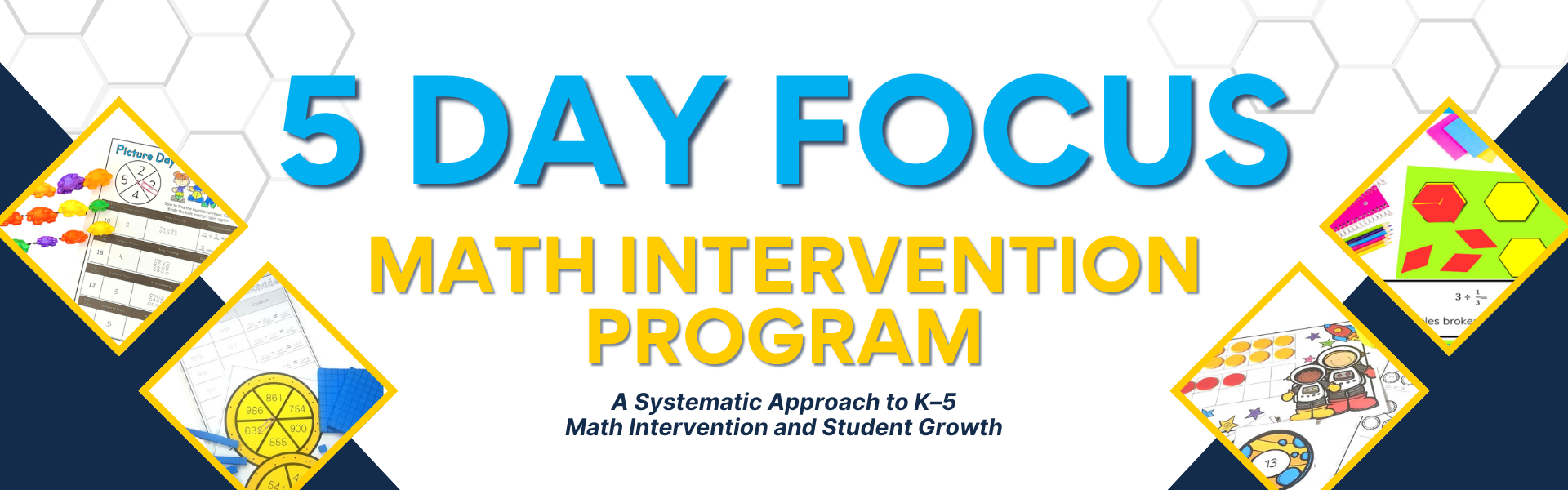
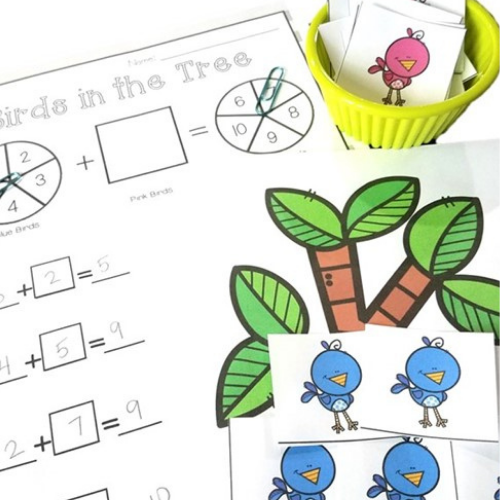
5-Day Focus Math Intervention is a comprehensive K–5 system designed to address unfinished learning with precision. Each unit targets a single skill or standard using a clear Concrete–Representational–Abstract progression, allowing teachers to meet students exactly where they are.
Targeted math Intervention
Designed for classroom teachers, interventionists, and support staff working with students who need focused, skill-based math support. This system helps educators quickly identify where students are, deliver targeted instruction, and move students toward independence with clarity and consistency.
Designed for Growth
- Students with unfinished learning in foundational math skills
- Intervention groups requiring targeted, skill-based instruction
- Classrooms needing structured support alongside core instruction
- Schools seeking a consistent approach to intervention using research-based strategies
Research-Based Practices That Drive Student Growth

The 5-Day Focus Math Intervention Program is grounded in research-based instructional practices that support meaningful, lasting student growth. Each component is intentionally designed to align with how students learn best, ensuring that intervention time is both effective and efficient.
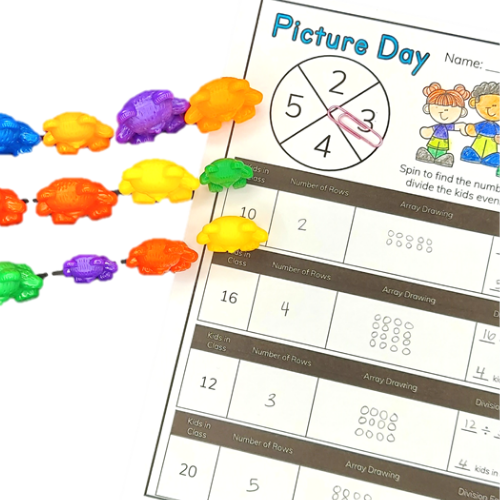
- Concrete–Representational–Abstract (CRA) progression
Instruction moves from hands-on experiences to visual models and finally to abstract reasoning, building deep conceptual understanding. - Diagnostic-informed instruction
Pre-assessments identify specific skill gaps, allowing instruction to begin exactly where students need support. - Ongoing progress monitoring
Daily exit tickets and structured checkpoints provide real-time insight into student understanding and guide instructional decisions. - Targeted, skill-based focus
Each unit isolates a single skill or standard, supporting intentional instruction and reducing cognitive overload. - Embedded problem solving and application
Students engage in meaningful story problems that connect mathematical understanding to real contexts and promote flexible thinking. - Student reasoning and mathematical discourse
Lessons are designed to encourage students to explain their thinking, justify solutions, and engage in purposeful mathematical conversation. - Opportunities for conjecture and generalization
Students are supported in noticing patterns, forming conjectures, and testing their ideas—developing deeper reasoning and transferable understanding. - Aligned independent practice
Students build confidence and independence by applying newly developed skills in a structured and supportive way.
Simple structured implementation
A clear, systematic structure guides every step from assessment to independence.
Use targeted pre-assessments to pinpoint exactly where students are in their understanding. Included you will find a pre and post assessment for each unit so you are able to ensure that the unit is the right fit for your students and also prove growth at the conclusion of the unit.
Each unit focuses on a single skill or standard, using a clear Concrete–Representational–Abstract progression to build deep understanding.
Over the course of 5 lessons** students begin with hands-on materials and progress toward mastery of the standard.
Lessons are anchored in meaning, discussion, examination of patterns, problem solving and ultimately in effective and efficient math strategies.
**Kindergarten units develop skills over the course of 10 lessons. The kindergarten program has a major focus on early numeracy and number sense. These skills benefit from a longer teaching period with additional time and space for practice and mastery.
Students apply their learning through daily structured practice activities. Students work toward the goal of independent mastery of the target skills and standards.
These activities are fun! Your students will be excited to play the math games during each session. Independent practice activities are thoughtfully created so that they often times can be used again and again for additional review and independent practice.
If you have ever thought to yourself “my students could do this at the small group table, but when they are on their own their confidence and skills fall apart!” then you will appreciate that there is a daily focus on independence in math skills.
Daily progress monitoring provides real-time insight, allowing instruction to respond to student needs immediately.
End of unit assessments provide clarity and provide the data and documentation needed to confidently take next steps.

What's included?
Each grade level is comprised of 8-15 units. Each unit is designed to make planning and delivering effective intervention instruction simple, providing everything needed to assess, instruct, and support independent student success.
**This program is delivered through a digital portal but is a printable program.**
- Pre- and Post-Assessments Used to identify student needs and measure growth over time. Ideal for data meetings, progress reports, and instructional planning.
- 5 Structured Lessons Each unit includes five carefully designed lessons grounded in the Concrete–Representational–Abstract progression to build deep conceptual understanding.
- Daily Independent Practice Students apply their learning independently each day, building confidence and ensuring skills transfer beyond the small group setting.
- Daily Progress Monitoring Tickets out the door provide immediate insight into student understanding, allowing instruction to adjust in real time.
- Unit Overview and Teacher Guidance Clear introductions and at-a-glance overviews keep instruction organized and focused on the target standard.

grade level resources at a glance
Primary
Unit 1: I Can Learn Numbers to 5
Unit 2: I Can Learn Numbers to 10
Unit 3: Playing With Numbers to 10
Unit 4: Exploring Addition
Unit 5: Exploring Subtraction
Unit 6: I Can Learn Teen Numbers
Unit 7: Playing With Teen Numbers
Unit 8: Progressing My Addition & Subtraction Skills
Unit 1: The Meaning of Addition
Unit 2: The Meaning of Subtraction
Unit 3: Partners of 10
Unit 4: Understanding Teen Numbers
Unit 5: Counting On
Unit 6: Addition & Subtraction Fact Families
Unit 7: Missing Numbers in an Equation
Unit 8: Comparison Relationships
Unit 9: Make a Ten Addition Strategy
Unit 10: Understanding 2 Digit Numbers
Unit 11: Comparing 2 Digit Numbers
Unit 12: Adding & Subtracting Decade Numbers
Unit 13: Adding Sums to 100
Unit 14: 10 More/10 Less Mental Math
Unit 1: Addition and Subtraction to 20 Strategies
Unit 2: Addition and Subtraction to 20 Relationships
Unit 3: Understanding 2-Digit Numbers
Unit 4: Understanding 3-Digit Numbers
Unit 5: Comparing 3-Digit Numbers
Unit 6: 10 or 100 More/10 or 100 Less
Unit 7: Addition & Subtraction to 100 Decomposing Strategies
Unit 8: Addition & Subtraction to 100 Number Line Strategies
Unit 9: Addition & Subtraction to 100 Related Fact Strategies
Unit 10: Addition to 100 (Strategies Related to the Algorithm)
Unit 11: Subtraction to 100 (Strategies Related to the Algorithm)
Unit 12: Addition to 1000 (Strategies Related to the Algorithm)
Unit 13: Subtraction to 1000 (Strategies Related to the Algorithm)
Unit 14: Multiplication & Division Foundations

Intermediate
Unit 1: Equal Groups Multiplication
Unit 2: Equal Groups Division
Unit 3: Arrays
Unit 4: Patterns in Multiplication
Unit 5: Elapsed Time
Unit 6: Multiplication & Division Fact Families
Unit 7: Rounding to the Nearest 10 and 100
Unit 8: Distributive Property Multiplication
Unit 9: Comparison Word Problems
Unit 10: Area and Perimeter
Unit 11: Multiplying by Groups of 10
Unit 12: Naming Unit Fractions
Unit 13: Naming Fractions
Unit 14: Comparing Fractions
Unit 15: Line Plots
Unit 1: Reading, Writing & Comparing Whole Numbers
Unit 2: Place Value 10x More 10x Less
Unit 3: Rounding Multi-Digit Numbers
Unit 4: Addition & Subtraction of Whole Numbers
Unit 5: Multiplication as Comparison
Unit 6: Factor Pairs & Prime Numbers
Unit 7: Multiplying a 1-Digit by Up To a 4-Digit Number
Unit 8: Multiplying a 2-Digit Number by a 2-Digit Number
Unit 9: Multi-Digit Division
Unit 10: Fraction Equivalence & Comparison
Unit 11: Adding & Subtracting Fractions
Unit 12: Multiplying a Fraction by a Whole Number
Unit 13: Connecting Fractions & Decimals
Unit 14: Measurement Conversion
Unit 15: Area & Perimeter
Unit 1: Understanding and Comparing Decimals
Unit 2: Powers of Ten
Unit 3: Rounding Decimals
Unit 4: Multi-Digit Multiplication
Unit 5: Division with 1-Digit Divisors
Unit 6: Division with 2-Digit Divisors
Unit 7: Decimal Operations
Unit 8: Adding and Subtracting Fractions with Unlike Denominators
Unit 9: Fractions as Division
Unit 10: Multiplying a Fraction by a Whole Number
Unit 11: Multiplying a Fraction by a Fraction
Unit 12: Dividing Unit Fractions by Whole Numbers
Unit 13: Dividing Whole Numbers by Unit Fractions
Unit 14: Measurement Conversions
Unit 15: Volume Concepts and Problem Solving

Program Pricing & Access

The full 5-Day Focus Math Intervention Program is designed to be both comprehensive and affordable for schools.
Full K–5 Program
$275 per teacher license
Includes digital access to all 6 grade levels
- Digital access runs from June 1, 2026 through June 30, 2027
- All resources can be downloaded during that time for continued use
Continued Access
$25 per year per license
- Maintain digital access beyond the initial term
- Licenses are transferable within your school or district
Flexible Options Available
Individual grade levels and custom bundle pricing are available upon request.
This program is delivered via a digital portal but is a fully printable program.
© The Math Spot • Website by KristenDoyle.co