
Description
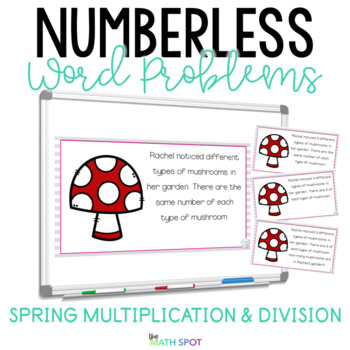
Numberless word problems help your 3rd grade and 4th grade students to focus on the action and context of a story problem rather than being “number pluckers”! Your students will be successful in solving multiplication and division word problems through these thoughtful spring word problems!
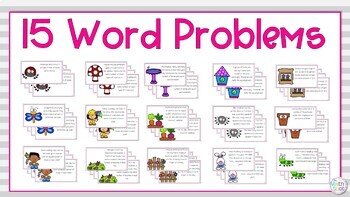
Each of the 15 projectable spring word problems works in a sequence.
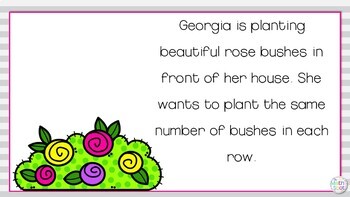
- The first slide gives the students a context with no numbers at all.
- The second slide adds just a bit of information by adding in one number amount.
- The third slide adds in the rest of the numeric information… but something is missing.
- The fourth and final slide in each problem adds in the question the students will be solving.
The clickable table of contents makes this resource incredibly easy to use. Problem types including equal groups (missing total and group/number in a group), area and arrays (missing product and missing multiplicand/multiplier) and comparison problems.
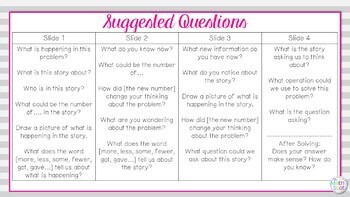
A slide including suggested questions to ask on each slide has also been included. The conversation is the most powerful component of these problems and the question stems will help you to have rich conversations with your students!
________________________________________________________________
Looking for NUMBERED word problems?
Addition & Subtraction to 20 Word Problem Notebooks
Addition & Subtraction to 100 Sort and Solve Word Problems
Looking for more NUMBERLESS word problems?
Addition & Subtraction to 20 Numberless Word Problems
Addition & Subtraction to 100 Numberless Word Problems
And remember, follow my store so you will be updated when new resources are added! I list many products on sale for the first 24 hours!
Joyce B. (verified owner) –
Originally reviewed on TPTWord Problems
A great introduction to word problems. It helps students understand what is being asked.
Amanda Mattson (verified owner) –
Originally reviewed on TPTThis was an excellent resource for my third grade classroom!
Tamela B. (verified owner) –
Originally reviewed on TPTI had a new teacher needing a resource so I purchased this for her to use in her classroom. She loved it! It was easy to use. Numberless word problems are truly the key to unlocking comprehension of word problems!
LolaBee Design Shop (verified owner) –
Originally reviewed on TPTI am incorporating these into our math spiral. The class is loving it! They are the perfect activity to help students think about word problems. Thank you!!
Susan C. (verified owner) –
Originally reviewed on TPTThis is such a great resource for practicing word problems! The first of 4 cards in each set of cards takes the numbers out of the way so that students just have to visualize the story, then gradually numbers are added. This is great for any student who is a “number grabber”. My students actually enjoy trying to come up with the question for the 4th card in the set. Try this resource. There are several different sets available and one is as great as the next.
Catherine K. (verified owner) –
Originally reviewed on TPTPerfect for distance learning with my class!
Katelyn F. (verified owner) –
Originally reviewed on TPTI first heard of numberless word problems on TikTok, and as an ELD teacher who needs to teach language for mathematics, I thought this would work great to bring attention to the language found in mathematics.
Since I’m a relatively new teacher, and I’m not qualified to teach mathematics (only the language used in it), I wasn’t really sure how to approach teaching it. Therefore, I was really relieved to find that this resource included a suggestion question sheet to go with each slide.
When it came to actually using it, I don’t think I prefaced it as appropriately as I should have. I brought it out to my 3rd grader (I work individually with this student) and she was really confused. So I explained why we were doing numberless word problems, but I knew she still wasn’t really on board.
I tried to follow the questions pretty closely because it was my first time trying to do numberless word problems, but in the moment and with how the student was leading her exploration of the word problem, I didn’t necessarily hit all of those questions. And I’ll be honest, with the bravado she was showing, I was starting to doubt if this was actually going to be helpful for her.
And that’s when we hit slide 3. Slide three said, “Ladybugs are sitting in groups of 7 on top of 4 green leaves.” In previous slides, she kept saying that there had to be 4 groups cause there were 4 leaves, but once we hit slide 3 she said, “there are 7 groups of ladybugs.” This was the first moment when I realized just how useful numberless word problems are for extracting language used in mathematics. This was a perfect example of how the language of mathematics creates a barrier for multilingual learners and why that language needs to be explicitly taught. But that wasn’t even the best part.
After clarifying the meaning of the phrase, we moved onto slide 4. This is when it went down and when I had probably one of the most exciting teaching experiences of my life. First, I should say that she was definitely taking charge of this experience. Before I could even say anything, she was pulling out numbers and answering the question. I figured, “hey, we can ask the questions after she goes through it.” Well, she came up with the correct answer, but when I asked her what operation she used, she said addition. Not what I was expecting. She clarified by saying that she added up all the ladybugs on her drawing which is how she got addition, but that she could also just multiply by the groups and get the same number.
Straying from the questions sheet, I asked, “so how do you know it’s addition or multiplication?” This is when I really started getting into this. First, she pointed to the word “altogether”. So on the spot, I came up with a subtraction word problem and used the same “How many ladybugs are on the leaves altogether?” question at the end. Well, she realized “altogether” didn’t really tell her anything about which operation to use. Instead, she just moved to the numbers in the problem. At this point, she’s pretty fired up about proving her point and I’m really fired up about having her discover which words in the problem are actually telling her to multiply, so when I come up with an addition problem with the same numbers she pulled and she realized that the answer would be different, you can just imagine her outburst. She whipped around to look at me and shouted, “well that’s because this problem (the wordless one) says groups!” And right after she said that I could tell that it clicked. The widening of the eyes, the sheepish look, the half-mumbled apology for shouting in her burst of passion. All of it. It was so rewarding to see her recognize not just what she implicitly picked up on (how the word “groups” affected the operation), but also why the language in math problems is so important.
I already knew from the onset that numberless word problems were going to be effective, but I had no idea how effective until I used one with a student. I imagine that with more preparation on my end and additional practice, this will prove to be one of my favorite strategies for unlocking the key to the language of mathematics.
I see this resource and others like it as a fantastic resource for language teachers and I would encourage other ELD teachers to try out these wordless math problems to identify areas of linguistic complexity and to teach the language of mathematics.
Thank you for such a thorough and fantastic resource! My discovery of it has been one of the highlights of this quarter.
Heather P. (verified owner) –
Originally reviewed on TPTGreat resource to use with a small group of students with learning difficulties.
Michele W. (verified owner) –
Originally reviewed on TPTLooking forward to using this with my students!