


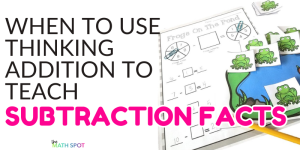
Subtraction Fact Fluency Through Thinking Addition
Before we talk about subtraction facts, we need to slow down and talk about subtraction itself. Step one in teaching subtraction fluency is making sure students understand what subtraction is and what it does. Subtraction is not just a set of facts to memorize. It represents relationships between numbers, and
Moving From Fact Fluency Strategies to Memory Through Recall
Week 5 of our focus on fact fluency is an interesting one, because this is where we make a shift. Miss weeks 1-4? Start here Week 1 | Week 2 | Week 3 | Week 4 Up until now, I have spent a lot of time advocating for number sense,
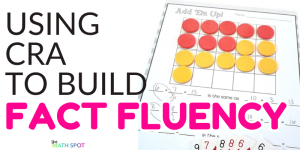
How to Use the CRA Framework To Teach Fact Fluency
Over the last few weeks, we have been building a clear picture of what a strong fact fluency strategy requires. In Week 1, we started by grounding ourselves in the standards. Knowing math facts from memory is a non-negotiable. I shared an assessment so teachers could see where their students
What Number Sense Has to Do With Fact Fluency
Fact fluency is often treated like something we should be able to squeeze in quickly. A game you play for a few minutes at the end of math if there is time left. When students struggle, the response is usually to add more practice and repetition. For most students, fluency
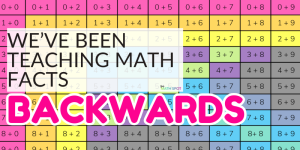
A Better Way to Teach Math Fact Fluency Through Number Relationships
We’ve been teaching math facts backwards. The second-grade standards ask students to know from memory all sums of two single-digit numbers. On paper, that looks like one hundred individual facts. It’s absolutely no wonder at all that so many students feel overwhelmed and discouraged. And it’s also no wonder that
Knowing Math Facts From Memory is a Non-Negotiable
Math facts are one of those skills that ripple out into almost everything else students do in the math classroom. When a student does not know basic facts, every task feels like walking through quicksand. For example, adding 23 plus 15 using mental strategies becomes an arduous task if a
What a College Geometry Session Taught Me About Teaching Elementary Math
A few weeks ago, I went to a conference where it felt like every presenter started their session the same way. They would say something like, “Pretend you don’t know how to solve this,” and then walk us through manipulatives, models, or routines that would help a student who truly

What Frustrates Middle School Teachers about Fraction Instruction
I sat in on a session at AMTNYS (Association of Mathematics Teachers of New York State) a few weeks back that was all about using hands-on tools to teach fractions to middle schoolers. I went in expecting to learn about advanced models or next-level strategies that would show where fifth
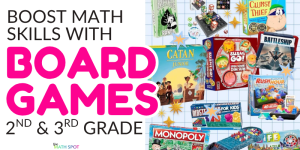
Board Games Gift Ideas to Boost Math Skills in 2nd and 3rd Graders
In math we can support our students to understand concepts but, at the end of the day, they need to practice those skills over and over to become fluent and confident mathematicians. This collection of board games gives your students the repeated practice they need while remaining engaged in board
Why Students Struggle with Word Problems, Part 3: Managing Cognitive Load
If you’ve been following along with our Word Problem Bootcamp, we’ve already looked at two big challenges. In Week 1, we talked about comprehension, when students don’t truly understand what’s happening in the story. In Week 2, we talked about connection, when students understand the story but can’t yet connect