This post contains affiliate links. This means that when you make a purchase, at no additional cost to you, I will earn a small commission.
Concrete materials help students understand math in a tangible way.

Imagine I met someone who had never had an apple before. If I told them, “I had an apple for lunch,” they might be able to deduce that an apple is food because I ate it for lunch, but that is about all they would know.
If I showed them a picture of an apple, they would know a little more. They might be able to relate it to another food they already know. They might even have an idea that it is a fruit. But there would still be a lot they did not understand about an apple.
Now imagine I handed them an actual apple and said, “Take a bite.” Suddenly they know what an apple is in a much more complete way. They understand how it feels, how it smells, how it tastes and what happens when they bite into it.
This is the goal of concrete materials in math.
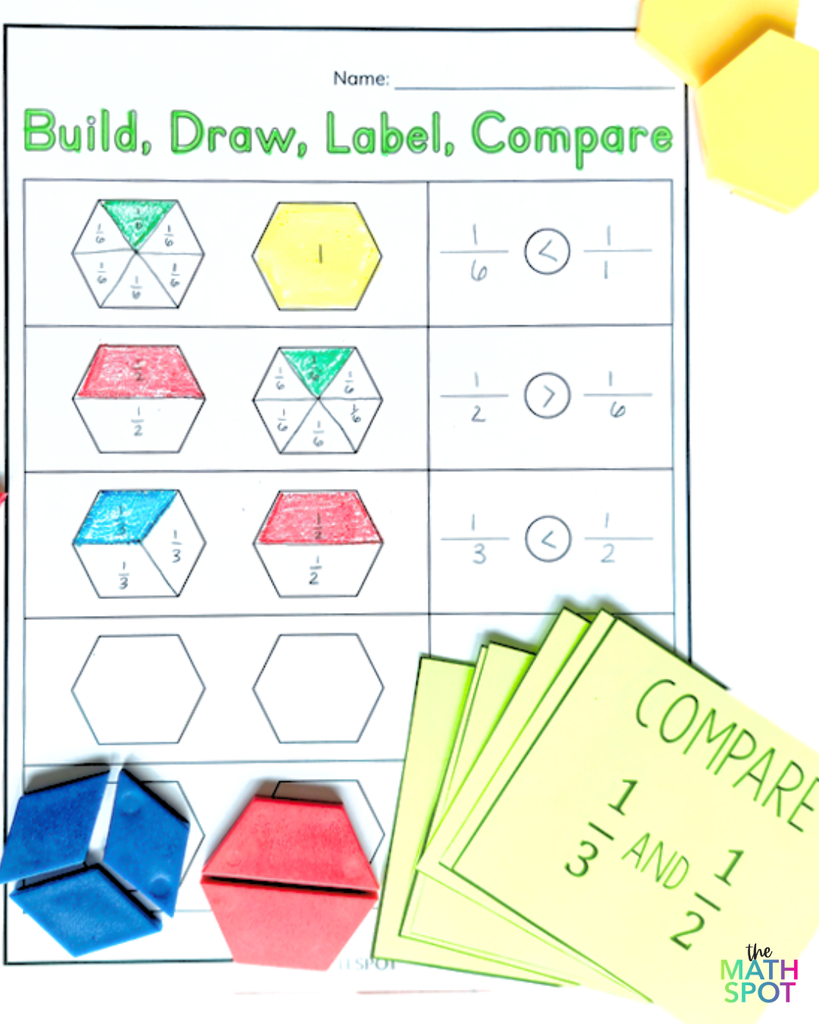
A student adding 25 + 37 might be told that there are enough ones to “make a new ten,” but that is a wildly abstract concept! Instead, give that student linking cubes and allow them to use the tool to add the numbers together. They can physically put 5 cubes and 7 cubes together and quickly see that those cubes can be regrouped to make a new group of ten.
The manipulative gives meaning to the words make a new ten. Skipping this concrete stage steps over an opportunity for students to build an understanding of the math they are being asked to do.
But All Concrete Materials Are Not Created Equally
It is important to remember that all concrete materials do not provide the same level of support.
I like to think about the entire Concrete, Representational, Abstract model as levels of support toward understanding, with concrete providing the most support and abstract providing the least. But there are levels of support within the concrete stage too.
Understanding those differences can help you choose the manipulative that gives each student exactly the amount of support they need.
Proportional and Groupable Models
The most supportive concrete models are tools such as:
- Linking cubes
- Bundles of straws
- Beans in cups
- Counting bears
- Counters or other individual objects

These models are both proportional and groupable. Students can physically move every individual piece. Ten cubes really are ten individual cubes. A group of ten straws can be taken apart and turned back into ten individual straws.
That ability to build and break apart quantities is incredibly powerful for students who are still developing an understanding of our number system. A student can physically gather ten individual cubes together and create a group of ten. They are not simply being told that ten ones are equivalent to one ten. They are doing it.
The tradeoff is that these tools eventually become cumbersome. Building 37 with individual cubes is manageable. Building 437 starts to become a whole different activity! That is when we can move to a slightly less supportive concrete model.
Pre-Grouped Proportional Models
A pre-grouped proportional model, such as base-ten blocks, allows students to work more efficiently while still showing the relative size of the numbers they are working with.

A ten stick really is ten times the length of a one cube. A hundred flat really is made up of ten tens. The quantities are already grouped for the student, which makes the tool easier to use with larger numbers, but the proportional relationship is still visible.
Now stop and think about a student who is adding 23 + 8 using base ten blocks. Your student might look at the 3 ones and the 8 ones and know that 8 + 3 equals 11. But the idea of “trading” ten ones in for a ten rod might still be tripping them up.
Instead of continuing to explain the trade with the same manipulative, you can recognize that the pre-grouped model is not offering enough support and step back to a groupable model like linking cubes.
You are allowed (and encouraged!!) to switch between models as needed based on the students in front of you!
Now your student can physically combine the 8 cubes and the 3 cubes. They can make a group of ten themselves and clearly see that there is one cube left over. They have just experienced why ten ones can become one ten.

This is why understanding the levels of support within concrete tools matters. You are not simply asking, “Did I use manipulatives?” You are asking, “Did I use a manipulative that gives this student the level of support they need?”
** Read that last paragraph again, especially if you teach 2nd – 4th grade!
Pre-Grouped Non-Proportional Models
Finally, we have pre-grouped non-proportional models.
These include tools such as place value disks and even money. At some point, the numbers we are working with become large enough that even base ten blocks are cumbersome. If we are working with thousands, ten-thousands or larger numbers, proportional models would take up half the classroom!

A non-proportional model allows students to continue working with their hands without the hurdle of needing enormous materials or enormous amounts of space. A place value disk labeled 1,000 is the same physical size as a disk labeled 1, which makes the tool much more practical for large-number work.
The challenge is that the student can no longer rely on the size of the manipulative to show the relationship between the values. Because the model is non-proportional, students need a clear and solid understanding that:
- Ten ones are equivalent to one ten
- Ten tens are equivalent to one hundred
- Ten hundreds are equivalent to one thousand
The manipulative itself is no longer showing them that relationship. This means place value disks are incredibly useful, but they require more understanding from the student than a groupable or proportional model.
If you are working in a 3rd or 4th grade classroom, I absolutely think you should have a set of place value disks on hand. They allow students to continue working concretely as place value concepts grow into much larger numbers.
And, if you are teaching 3rd or 4th grade and you have a student who is struggling with a non-proportional model change the size of the numbers you are working with! Backtrack to numbers to 1,000 and use a proportional model like base ten blocks until your students have the understanding of place value that will allow them to progress to a non-proportional tool. And then, practice using that non-proportional tool with those smaller numbers!
Choosing the Right Concrete Model
The goal of concrete materials is not simply to make math more fun or give students something to touch. Concrete models give students a way to experience the mathematics before we ask them to reason about it entirely through pictures and symbols.
And just like we can move between concrete, representational and abstract models based on the support a student needs, we can move between different concrete models too. A student struggling with base ten blocks may need to step back to linking cubes. A student who understands base ten blocks but is working with numbers in the thousands may be ready for place value disks.
The question is not, “What manipulative goes with this lesson?” The better question is, “What tool will help this student understand the math?” That is the whole purpose of the concrete stage.
A Resource For You!

I have a free set of materials that provide student the opportunity to learn about math topics through hands on materials to share with you!
Within this pack you will find an activity for find:
- Kindergarten Numbers to 5
- First Grade Teen Numbers
- Second Grade Addition Strategies
- Third Grade Rounding
- Fourth Grade Place Value
- Fifth Grade Decimal Place Value
Each of these activities come from my 5 Day Focus Math Intervention program. I start the vast majority of my units with hands-on activities and then link from there to support students toward abstract understanding. Every unit is different and, depending on the topic, not every unit follows this progression but the vast majority do!