The most important thing to understand about a math diagnostic assessment is its purpose: to give you the information you need to make good instructional decisions.
A typical math intervention screener might give you a long list of skills a student cannot do. It may confirm what you already knew: this third-grade student is not yet successful with third-grade math. That information can help you identify a student who needs support, but it does very little to tell you where instruction should begin.
To plan intervention, I need to turn that question around. I need to know what my student can do. Once I understand what they know, I can look at the progression of skills and identify what they are ready to learn next.
Do You Need Another Math Intervention Screener?
Imagine I go to a running coach and tell them I want to run a marathon. A screener might tell the coach that I cannot run a marathon right now. Fair enough! It identifies that I need support to reach my goal. But where should coaching begin? Can I run a half marathon? A 5K? Can I run a mile? The coach still does not know.
That is where a diagnostic assessment comes in. My coach might start by asking whether I can move a mile. Am I running or walking? If I can run a mile comfortably, they can try a longer distance. What happens when I attempt a 5K?
As soon as the coach learns that I cannot run a full 5K without walking breaks, the assessment stops. They have the information they need to plan my training. I do not need to attempt a 10K just to confirm that I cannot run that distance either.
Math intervention works the same way. The goal is not to check every box or complete every question on an assessment. The goal is to find what a student can do and identify the next place instruction should begin. Once you have that information, stop assessing! We do not want to waste your time or your students’ time. There is too much good math to do.
If you have been searching for a printable math intervention screener, take stock of the information you already have. Your schoolwide screener, classroom assessments, and teacher observations may have already helped you identify the students who need intervention. The next question is: What do they know, and where should I start? That is the job of a math diagnostic assessment.
How the K–5 Diagnostic Continuum Is Organized
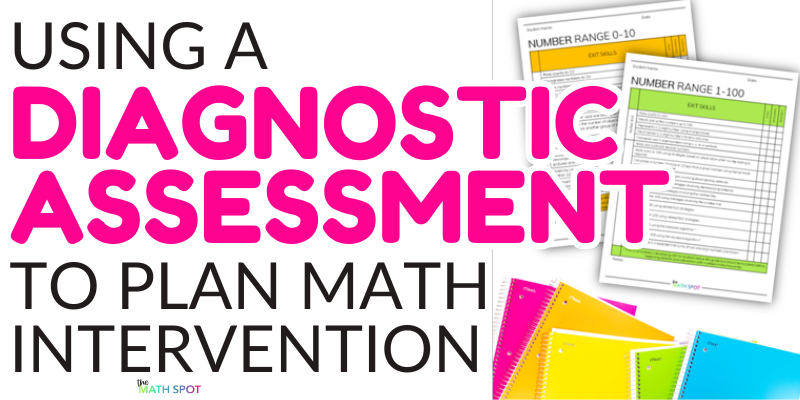
I created the K–5 Diagnostic Continuum to help teachers pinpoint where a student is in their understanding of numbers and operations. It does not produce a traditional score (in fact, it produces not score at all! There are other assessments that can do that). Instead, it helps you place a student along a continuum of skills, identify what they can already do, and find an instructional starting point.
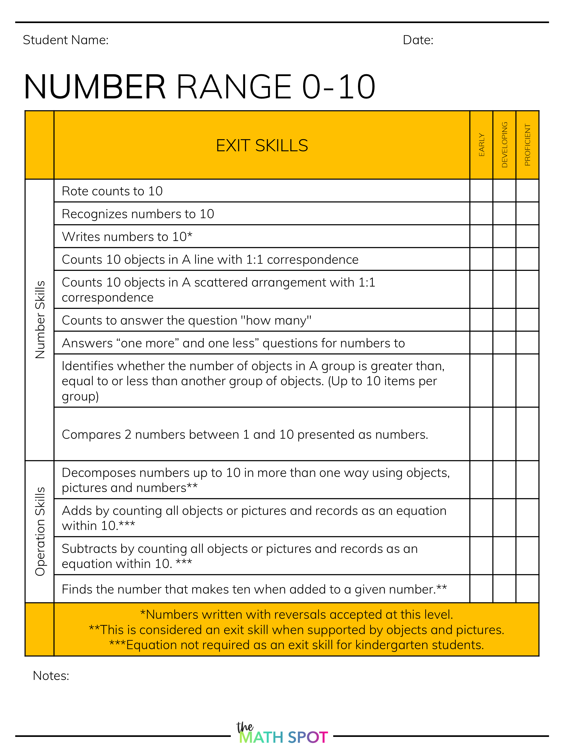
The assessment is organized into number ranges that reflect how students build their understanding of numbers and operations over time. Within each range, students are assessed on their knowledge of numbers and then on their understanding of operations with those numbers. Fractions and decimals are included where appropriate.
The ranges are designed to move from smaller to larger numbers while introducing new operations at points that make sense developmentally. This means the continuum does not always move in a straight line toward bigger numbers. When a new operation is introduced, it may bring students back to a smaller, more manageable number range. They can develop an understanding of the operation there before applying it to larger numbers.
Fractions are introduced in stages too, beginning with foundational ideas and benchmarks before moving into more complex fractions and fraction operations. Decimal numbers appear between fractions and full fraction operations, connecting place value understanding to fraction reasoning.
These shifts help you see both where a student is in their development and where instruction should begin. The lowest point of mastery tells you where to focus instruction, while higher skills can continue to be reinforced and strengthened over time.
How to Use the Math Diagnostic Assessment
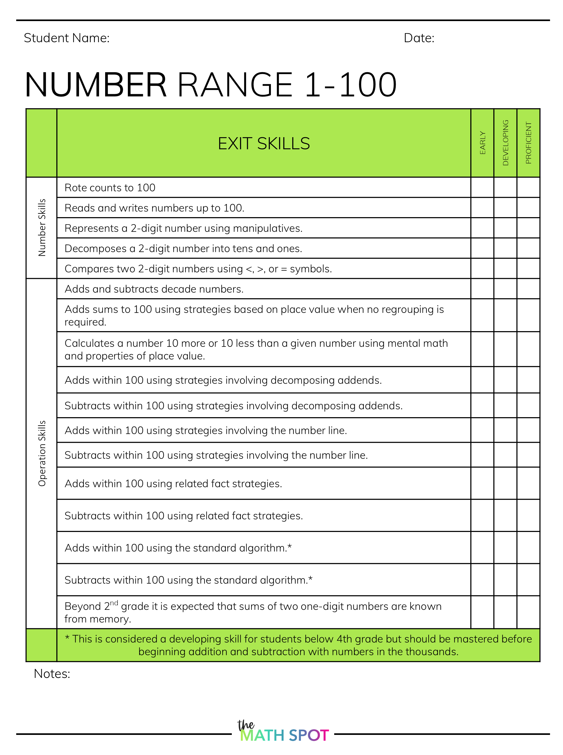
Begin by making an educated guess about the number range where your student understands the numbers conceptually but is still refining their work with operations. Use what you already know from classroom work, informal observations, and prior assessments. You do not need to begin every student at the first page of the diagnostic.
On the page for that number range, start with the numbers questions. These help you see whether the student understands the numbers themselves, including the relevant number sense and place value ideas. If the student is successful, move on to the operations questions in that same range. These show what the student understands and can do when working with those numbers.
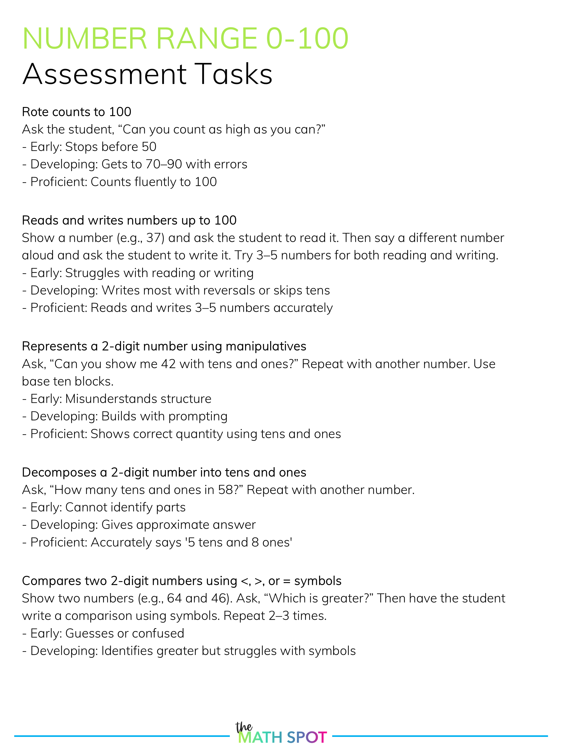
If the student can answer both sets of questions successfully, move to the next number range and repeat the process. If the student cannot answer the numbers questions, move immediately to the previous range and begin there. If the student understands the numbers but is not yet successful with the operations questions, you have found the range where instruction should begin.
Within each range, the skills are written in developmental order. Start with the first operation skill the student missed. That gives you a specific next step, rather than a general conclusion that the student is “behind.”
What Do I Do With the Results?
The assessment is meant to support your judgment, not replace it. Make decisions along the way about when to move forward, when to move back, and when you have enough information to stop. If you have enough information to make a strong, informed decision about where your instruction needs to go with a student, you can stop the assessment. Here is the basic decision process:
| If you find that… | Then… |
|---|---|
| The student understands the numbers in this range | Move on to the operations questions in the same range. |
| The student does not yet understand the numbers in this range | Move to the previous number range and begin again. |
| The student is successful with both numbers and operations | Move to the next number range. |
| The student understands the numbers but struggles with operations | Stop here. Begin instruction with the first operation skill missed. |
You may also see questions marked as developing skills. These are often skills, such as fact fluency or recalling facts from memory, that develop over time. Note them for ongoing support, but they do not need to prevent a student from moving to the next number range. You will see these skills appear again in later ranges until they are expected to be mastered.
The diagnostic has done its job when you can say, “Here is what this student can do, and here is the next skill I need to teach.” You do not need to finish every page to reach that conclusion.
From Assessment to Instruction
Once you have identified a starting point, you can plan instruction around that specific skill. You may have several students ready to work on the same idea, which can help you form a small group. You may also discover that students who received similar screener results need different starting points. That is exactly why you use a diagnostic!
The K–5 Diagnostic Continuum gives you a way to work through these decisions with students one at a time. Your assessment does not need to tell you everything a student cannot do. It needs to tell you enough about what they can do to make your next instructional decision. Then it is time to stop assessing and start teaching!
Have further questions? Feel free to email me at susan@k5mathspot.com I am always happy to chat about math!