
When I run Math Intervention Uncomplicated, I ask teachers to target a skill. This skill becomes the basis for the unit plan they create throughout the course. I ask teachers to come up with one very specific, small skill that could be targeted in one week of instruction. Every semester, without fail, teachers choose big skills like adding and subtracting with regrouping to 1,000,000.
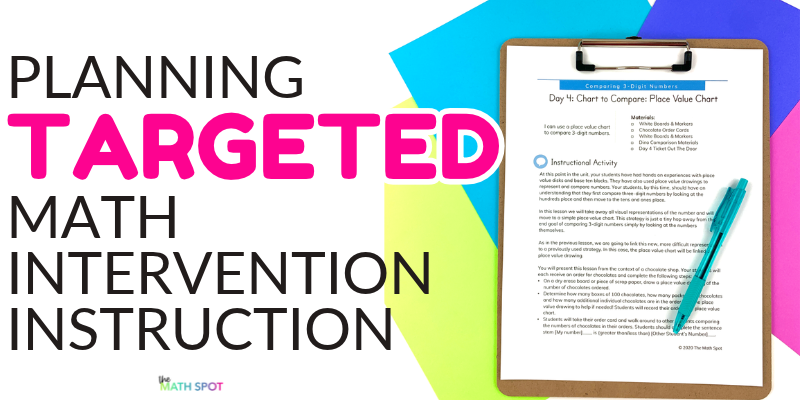
This skill does seem targeted and specific, but in a math intervention setting, for many students, it’s just too big! In an intervention setting, I want to pick one very specific and targeted skill that can be brought through the concrete, representational, and abstract (CRA) progression.
In math intervention, I want to be able to pretest and posttest a very specific skill, and I want to be sure that students are making progress along the way. Choosing a skill like addition AND subtraction with regrouping to 1,000,000 muddies the water.
Let’s choose one skill. Are we working on addition or subtraction calculation? Are numbers to 1,000,000 appropriate at this point in time, or do we need to start with smaller numbers? Is it the calculation itself that’s the need, or are your students able to calculate but struggle when it comes to story problems?
If you aren’t wildly clear on the exact skill you are working on, you will have more difficulty assessing and seeing progress in your students.
There is a chance that your students are very close to mastering addition and subtraction of multi-digit numbers and that this may be an appropriate focus for them. For many students receiving intervention, though, there is an underlying need for more specific work.
The most straightforward way to break down a large skill is to look at your state standards and the mathematics progressions documents. These documents help you see how mathematical understandings build across grade levels.
Walking through the example of addition and subtraction to 1,000,000, we would begin with the fourth-grade standard, CCSS.Math.Content.4.NBT.B.4. This standard calls for students to fluently add and subtract multi-digit whole numbers with the standard algorithm. The fourth-grade base-ten domain limits the numbers to 1,000,000 or less.
Already, we can spot two separate skills within this standard: adding multi-digit numbers using the standard algorithm and subtracting multi-digit numbers using the standard algorithm.
If we have students who may not be ready for numbers of this magnitude, we can step back further and look at the third-grade standard, CCSS.Math.Content.3.NBT.A.2. Here, students work toward fluent addition and subtraction within 1,000, drawing on place value, properties of operations, and the relationship between addition and subtraction.
Within this standard, we again have multiple skills: addition within 1,000 and subtraction within 1,000. There are a variety of strategies here, but with the fourth-grade skill we are working toward in mind, I would focus on strategies and algorithms based on place value.
If you suspect that your students may still not be successful with this work, step back further to the second-grade standard, CCSS.Math.Content.2.NBT.B.7. This standard includes adding and subtracting within 1,000 using concrete models or drawings and connecting those representations to a written method. Students work with hundreds, tens, and ones, including composing or decomposing tens or hundreds when needed.
In the second-grade standard, we can see that there is a focus on using concrete models and drawings and relating these to a written method. That gives us another way to narrow our instructional focus: we can look at both the size of the numbers and how students represent and solve the problems.
Assessment is the answer here! For a teacher who suspects their students need “addition and subtraction to 1,000,000,” we would walk back through the progression and check to see what the students already know.
Start with two-digit addition and subtraction, which appear in CCSS.Math.Content.2.NBT.B.5. Have hands-on materials and a whiteboard available. Don’t prompt your student that they must use them! Ask your student, “Could you add 28 + 34 together?” If they are successful, move on to subtraction: “Can you solve the problem 72 − 54?” Ask them to explain their thinking so you can understand how they arrived at their answers.
If at any point your student is NOT successful, stop and investigate. This may be where your instruction needs to begin. If your student is successful, move ahead to the next step, asking them to attempt addition and then subtraction with three-digit numbers.
It is, of course, possible that your student might not be successful even with the first step. If you ask your student to add 28 + 34 and they are not successful, you will need to dig a bit further to find the reason why.
Did your student calculate 8 + 4 incorrectly? You may be looking at a goal related to basic addition strategies, such as counting on. Did your student add 8 + 4 correctly, but then make a place-value error when adding? Ask your student to build the numbers 28 and 34 using base-ten blocks to determine whether they understand and can represent these numbers. That understanding will be critical to your instruction moving forward as you ask students to use hands-on materials!
Looking at my 5 Day Focus units, we find a number of units that may fit within this progression relating to addition and subtraction of numbers to 1,000,000:
Given all of these options, I start where I suspect my student might be successful. I ask them to add 24 + 38. They are successful! We move along. Next, I ask my student to subtract 72 − 55. They are again successful. We proceed.
I ask my student to add 234 + 178. The student is not successful. So I need to ask myself: why were they able to solve the problems with two digits but unsuccessful with three digits?
I suspect a place value misunderstanding and ask them to build the numbers 234 and 178 with base-ten blocks. I ask them what happens to our blocks when we put 8 ones and 4 ones together. The introduction of hundreds proves to be the hurdle. I decide to start their instruction with the second-grade Understanding 3-Digit Numbers unit and plan to follow this with the second-grade Addition to 1,000 and Subtraction to 1,000 units since I suspect they will already be successful on the units adding numbers to 100.
After confirming their understanding with a few more problems or the unit pretests, I can “skip” the Addition to 100 and Subtraction to 100 units because my student has demonstrated that they can successfully add and subtract two-digit numbers.
We started with a big goal: adding and subtracting numbers to 1,000,000. Now we have a specific starting point and a plan for what comes next.
If you are using my 5 Day Focus units, we have a built-in check. Choose the unit you are starting with, in this case Understanding 3-Digit Numbers, and give your students the pretest. If your student already shows mastery of the content on the pretest, you can skip the unit and move to the next.
The units are already ordered so that they build upon one another with respect to both number ranges and operations. When you finish a unit, simply give the next pretest in order. If your students demonstrate mastery on the pretest, move along to the pretest for the next unit!
There’s no sense in spending your students’ instructional time on content they already understand. As soon as your student reaches a pretest they have not mastered, stop and deliver instruction!
The next time you sit down to plan math intervention instruction, start by asking yourself whether the skill you have chosen is small and targeted enough. If it still includes multiple operations, a wide range of numbers, or several underlying understandings, break it down further. You can keep that big goal in mind while choosing one very specific piece to tackle next. That smaller focus will make it easier to plan your instruction, see your students’ progress, and know when they are ready to move forward!