This post contains affiliate links. This means that when you make a purchase, at no additional cost to you, I will earn a small commission.
We’ve been teaching math facts backwards.
The second-grade standards ask students to know from memory all sums of two single-digit numbers. On paper, that looks like one hundred individual facts. It’s absolutely no wonder at all that so many students feel overwhelmed and discouraged. And it’s also no wonder that teachers cite “students don’t know their facts” as one of the biggest barriers to future math instruction.
The problem is that this approach is backwards. We can’t start with the facts themselves.

But there is good news. Students do not need to memorize one hundred unrelated facts. They only need to understand a small set of number relationships that allow them to remember and apply ideas instead of trying to memorize dozens of isolated combinations.
When we group facts by relationship instead of treating them as one giant list, students learn faster, and recall with far greater ease.
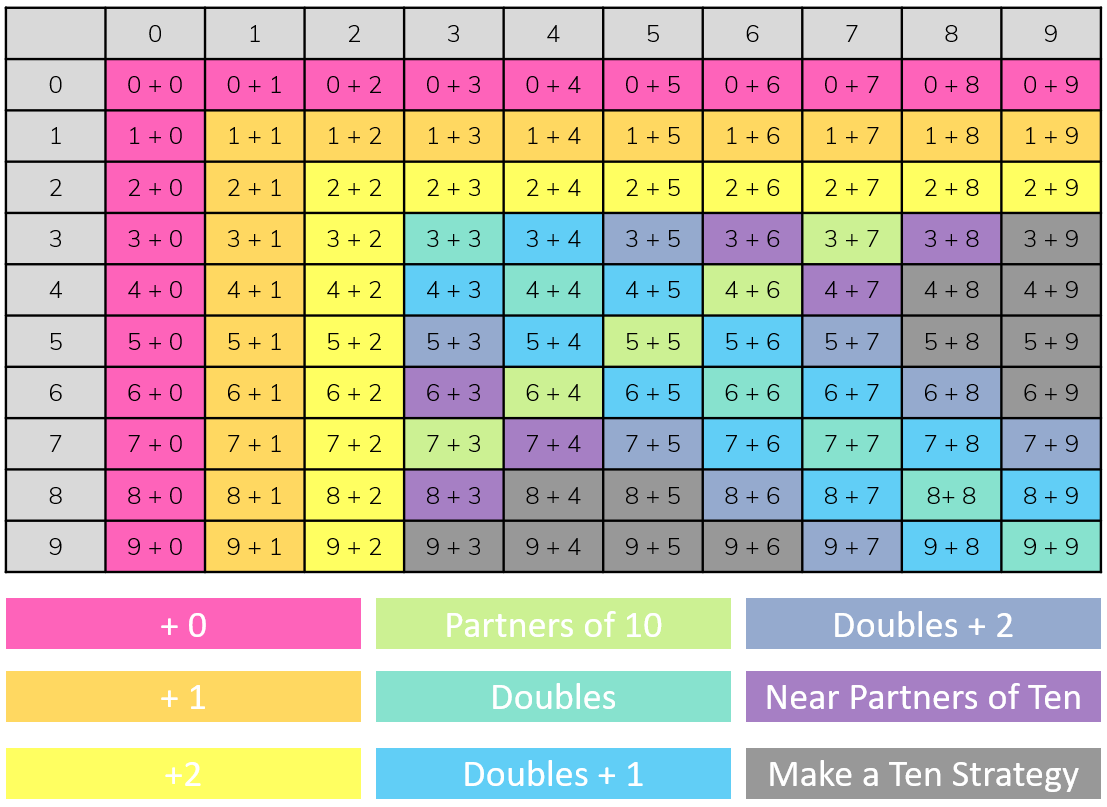
Below is the chart I use to sort fact relationships. I want you to notice how we can reach ALL sums of single digit numbers inside of these 9 relationships. Rather than expecting students to remember many separate facts, we help them understand a single idea that applies again and again.
Let’s take a look at each relationship.
Adding Zero
Instead of memorizing every fact where zero appears, students can learn the identity property:
Whenever zero is added to a number, the number stays the same.
This single idea replaces nineteen separate facts and helps students build confidence quickly.
Adding One
Students naturally connect +1 facts to the concept of “one more.” They already practice this idea when they count forward by ones, so these facts become automatic with very little additional instruction. Teaching the relationship behind +1 helps students avoid counting all and leads to fluency with one meaningful idea rather than memorizing another nineteen combinations.
What you need to keep in mind here (and this is true for all fact relationships) is that just because your students know that one more than 7 is 8 DOES NOT mean that all students will recognize 7 + 1 as that same idea. You will need to provide explicit instruction to help students make this connection.
Adding Two
When students see +2 facts, they often think of “two more.” These facts support the shift from counting strategies to early mental strategies. They can use their understanding of counting on or adjusting known facts to make these combinations efficient and accurate.
The idea of “two more” is also an early number sense relationship. Number sense work can be explicitly connected to equations to support your students learning these facts.
Partners of Ten
Partners of ten are one of the most powerful fact categories. Again, this set of facts is supported by early number sense work and the benchmarks of 5 and 10! Students learn how numbers work together to make ten, and this relationship becomes the anchor for so many other strategies.
Once students know that 6 and 4 make ten, or that 8 and 2 make ten, they can use this structure in both addition and subtraction. This set supports mental math well beyond the facts within ten.
Doubles
Doubles are memorable because they have a clear pattern. Students often enjoy learning them, and once these facts are automatic, they serve as a reference point for more challenging combinations. Knowing that 6 plus 6 is 12 can help a student solve 6 plus 7 or 6 plus 8 with efficiency.
Grabbing all of the “double dominoes” out of a set and playing games with these materials can help students solidify these facts quickly!
Doubles Plus One
The remaining sets of facts are derived from earlier number relationships. You will need mastery on teh first 5 relationships before moving into these final 4!
These facts are directly connected to the doubles set. Students can think, “I know 7 plus 7 is 14, so 7 plus 8 must be one more.” This helps students move away from counting and toward relational thinking. They are not memorizing two unrelated facts, they are using one to find the other.
As a teacher this can feel frustrating because you are putting a step in between these facts and your students knowing these facts from memory. We are looking for fluency with the “doubles plus one” strategy first.
Consider though, if your students memorize 7 + 8, at the end of the day they only know 7 + 8. If you help your students to see 7 + 8 as a “near doubles” problem, your students then can answer 7 + 8 but they can also answer 8 + 7 and down the line they can even solve problems like 27 + 38 or 70 + 80. They have more than a “naked numbers” fact in their mind, they have an understanding about how to flexibly combine these numbers.
While memorization IS the end goal for addition facts, supporting your students through reasoning will get them to the end goal while also supporting future goals in a meaningful way.
Doubles Plus Two
This relationship is the next natural step after doubles plus one. Students extend their thinking from “one more than the double” to “two more than the double.” These facts support flexible strategy use and reinforce a student’s understanding of how numbers can be flexibly decomposed and combined.
Near Partners of Ten
Near partners of ten are combinations that are close to making ten but not exact partners. Students who understand partners of ten can adjust slightly to find these combinations. For example, knowing 6 and 4 make ten helps them reason about 6 and 5. These near partner facts support both addition and mental subtraction strategies.
This is the same exact idea as doubles plus one and doubles plus two but you are simply starting from a different foundational fact relationship.
Why These Relationships Matter
When students learn facts through number relationships, they internalize ideas rather than memorizing isolated facts. They begin to see structure in our number system and develop efficient strategies. They build accuracy and flexibility that ultimately prepares them to recall facts from memory.
Students will still need plenty of repeated exposure and practice to move from understanding relationships to facts from memory but the task is made more managable. There is no short cut to practice!
Free Addition Inventory
To help you determine exactly where your students fall, I created a free Fact Fluency Inventory. This quick tool gives you a snapshot of which addition relationships your students are already comfortable with and which might need more support. I recommend administering it in very small groups, ideally no more than three students at a time. Your observations are just as valuable as the answers students write.

ADDITION FACT FLUENCY