This post contains affiliate links. This means that when you make a purchase, at no additional cost to you, I will earn a small commission.
Over the last few weeks, we have been building a clear picture of what a strong fact fluency strategy requires.
In Week 1, we started by grounding ourselves in the standards. Knowing math facts from memory is a non-negotiable. I shared an assessment so teachers could see where their students are right now on the path toward that expectation. At the same time, we acknowledged an important tension. If we jump straight to flashcards, we are asking students to memorize far too many individual pieces of information.
In Week 2, we found a solution to that problem by organizing facts through number relationships. Instead of treating each fact as its own task, we grouped facts into manageable categories that students can study.
In Week 3, we talked about what to notice when students are struggling with one of those categories. Very often, difficulty with a fact relationship points back to an underlying number sense relationship that is not yet firm. When students are stuck, it is worth looking beneath the facts themselves.
Now, in Week 4, we get to the question you might be asking at this point.
How do we actually teach these relationships to students?
The role of CRA
The answer, as it is with so many of my math resources, is CRA.
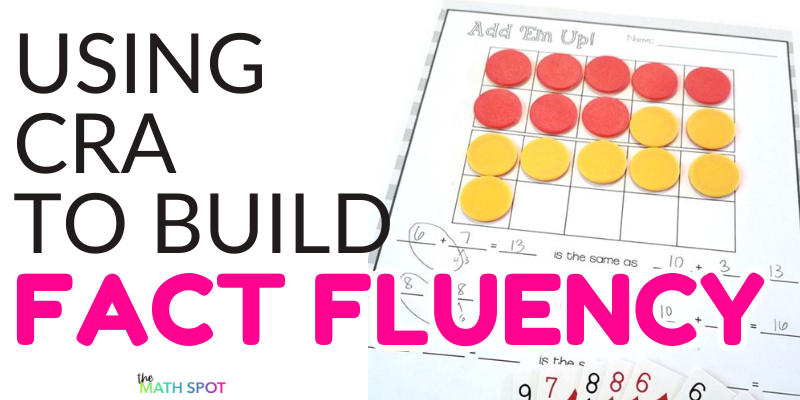
CRA stands for Concrete, Representational, and Abstract. If you want a deeper dive into the progression, here is a link to another post that explores it in more detail. For our purposes here, the idea is straightforward.
We start with hands on, concrete materials.
We intentionally link that work to representational drawings and models.
Only then do we expect students to work successfully with numbers, equations, and mental math at the abstract level.
Let’s look at how this plays out with specific number relationships.
Building a CRA pathway for +1 facts
Imagine a student who is still struggling with +1 facts. Based on what we discussed in Week 3, there is a good chance this student does not yet have a solid understanding of the one more relationship or the count sequence.
We can use CRA to build that understanding intentionally.
At the concrete level, we might start with linking cubes. The teacher can say out loud, “One cube. One more is… two. Let’s count to be sure. One, two.” Then, “Two cubes. One more is… three. Let’s count to be sure.” This work may feel simple, but it is doing important work around quantity and sequence. If your students don’t intuitively know what “one more” than a given number is, they need to do this work.
Another concrete activity might involve building number trains. Ask students to build a train that is five cubes long. Then ask, “How many cubes would we have if we added one more?” Say it together. “Five, one more is six.” Count the cubes to confirm. Along the way, the teacher can make the abstract connection explicit. “We started with five cubes and added one more. What would that look like as an equation?” Write 5 + 1 = 6 together.
DO NOT SKIP THIS EXPLICIT LINKING! Students do not automatically connect hands-on activities to equations unless we help them do so.
At the representational level, students might work with a number path. Ask them to locate the number 8 and then ask, “What number is one more?” Have them write an equation to match their thinking. Another option is drawing circles. Students draw a given number of circles, add one more, and then write the matching equation.
Each step builds toward the same idea, just represented in different ways.
Using CRA to Support Near Doubles
We can move through this same progression with more complex relationships, like near doubles.
At the concrete level, ask students to show 6 + 6 using linking cubes, all in the same color. Then add one more cube to one of the stacks in a different color. Ask, “What equation does this represent now?” and “What do you think the total might be?” Follow up with, “How can we tell without recounting all of the cubes?”
You can repeat this idea by giving students two stacks where most of the cubes are the same color. For example, one stack of five blue cubes and another stack of six cubes where five are blue and one is red. Ask students how many cubes there are in all and how they know.
A similar activity works well with a rekenrek. Slide across four beads on the top row and five on the bottom row. Ask, “How many beads are there altogether?” and “How do you know without counting every bead?” Always ask students to write an equation to match their thinking. Students do not naturally connect these number sense activities to math facts unless we help them make that connection explicit.
At the representational level, number bonds can support this same thinking. You might write an equation like 7 + 8 on the board and remind students that 7 + 7 is an easier fact. Ask if there is a way to decompose the 8 to take advantage of that known fact.
Repeating the CRA Process Across Relationships
This same CRA sequence can be repeated again and again for any number sense or number relationship. The materials may change, and the representations may look different, but the progression stays the same.
When students have opportunities to build understanding with concrete materials, connect that work to drawings and models, and then practice working at the abstract level, fact fluency becomes much more attainable.
CRA gives us a way to teach number relationships intentionally instead of hoping students will make sense of them on their own.
Math Intervention Resources From The Math Spot
Looking for sequenced instruction that supports number relationships and fact fluency? My kindergarten and 1st grade intervention bundles were built for this job. Each unit moves sequentially from concrete to representational to abstract supporting students as they build math ideas.
This done-for-you math intervention includes pre and post assessment, detailed lessons, independent practice activities and progress monitoring across the unit.