This post contains affiliate links. This means that when you make a purchase, at no additional cost to you, I will earn a small commission.
When a student is struggling, it’s really easy to feel like they need everything. Like we need to go all the way back, reteach it all, give more practice, just keep throwing things at the deficit until something sticks.
When I notice a student struggling, I’m not immediately thinking about lessons or strategies. I’m trying to figure out what kind of situation I’m in. Sometimes it’s a student struggling with something we’ve been working on recently. It’s a current skill, something we’ve taught this year, and it’s just not sticking yet. Other times, the difficulty is showing up in seemingly every skill. The student is barely hanging on even when you introduce new concepts because there are big gaping holes in their foundational skills.
Those lead to two different next steps.
If it’s a current skill that isn’t sticking
If I’m looking at a skill we’ve been working on this year, I stay with the skill. I just start asking better questions about it.
- 1) I’ll take the task they’re struggling with and ask myself, could they do this exact same task with much smaller numbers?
If I scale the numbers down and the work cleans up, then I’m probably looking at a numbers issue. The student understands what to do, but the size of the numbers is getting in the way.
If I scale it down and it’s still messy, now I know it’s not about the numbers. It’s something about the operation itself.
From there I want to know two things.
- 2) Do they understand what the operation does?
If I ask them what it means to add, subtract, multiply, or divide, can they explain it in a way that makes sense? Not perfectly worded, just enough to show they understand the idea.
- 3) Do they have a strategy to carry out the operation?
Knowing what operations mean and do and having strategies to solve are NOT the same thing. A student can understand what addition means and still not have a reliable way to solve a problem. Or they can be trying to follow steps or a procedure for a strategy without really understanding what’s happening.
From here, if I know I am dealing with a strategy deficit I shift into CRA questions:
- Could they do this with hands-on materials?
- What if I gave them a visual model?
- Are they being pushed to work abstractly before they’re ready?
That helps me figure out where, specifically, the instruction needs to begin.
Before I start teaching, I’ll usually give a quick pretest at that level. Just enough to confirm that I’m in the right place and not about to spend time on something they already know.
2nd Grade Example
Let’s say I have a second-grade student working on adding three-digit numbers with the standard algorithm. When it comes to regrouping, it’s all over the place. They’re writing little 1s above digits, but not in a way that makes any sense.
So I back up and give them a two-digit plus two-digit problem. If this were just about the size of the numbers, things should clean up here. But they don’t. The same confusion is still there. At this point, I know I’m not dealing with a numbers issue.
Next, I ask them what it means to add. They tell me it means putting numbers together. That’s enough for me to know they have the basic idea.
I know I’m looking at a strategy issue.
I bring in base ten blocks and ask them to model two-digit addition. I’m not jumping back to three-digit numbers. I already know that’s too much. I want to see what they can do at this level. They’re not able to combine and regroup in a way that makes sense.
Now I know exactly where to start. Not at the standard algorithm. Not at three-digit addition. I need to build a strategy for two-digit addition with regrouping using hands-on materials.
**As a side note, if you use my 5 Day Focus Math Intervention Curriculum, this is when you would choose the topic that corresponds with your students’ needs and give the pre-test. The process for HOW to teach this skill has been already worked out for you with instruction that develops from concrete to representional to abstract and with independent practice and assessment along the way.
And if they hadn’t been solid with single-digit addition, I would have gone back even further. This is always about finding the lowest point where things break down.
4th Grade Example
I have a fourth grade student working on adding fractions with unlike denominators. They are just adding across both the top and bottom to solve. Their answers do not make sense.
My first move is to check to see if they can add fractions with like denominators. They can. So now I know this isn’t an addition issue. They understand what it means to add, and they can do it when the fractions are already set up in a way that works. I’m thinking this is about understanding fractions as numbers and I am going to test that next.
I give them something like one-half plus one-fourth. As fractions with unlike denominators go, this is about as friendly as numbers can get! They can’t do it abstractly, so I bring in fraction circles (I’m thinking CRA now, could you do this with hands-on tools?) and ask them to show me what happens when we combine those two amounts.
Now they can do it.
So now I have a clear picture. They understand addition. They can add fractions with like denominators. They just don’t yet understand fractions well enough to find a common denominator on their own.
So instead of more practice adding fractions, I need to help them understand what just happened with those fraction circles and connect that to a strategy they can use without the tools.
What About Students Who Struggle Every Single Unit?
Sometimes it’s not just one skill that isn’t sticking. It’s showing up in multiple places. The student struggles across different types of problems, and it’s hard to even decide where to begin. The foundational gaps are large enough that it feels like the student needs “everything”.
At that point, I stop looking at trying to break down an individual math topic and start stepping back.
I want to know:
- What number ranges are truly solid?
- Which operations are secure, and at what level?
- Where does the student’s proficiency begin to fall apart?
This is where thinking in terms of a continuum is really helpful. Instead of guessing or jumping around, I’m looking for a concrete starting point.
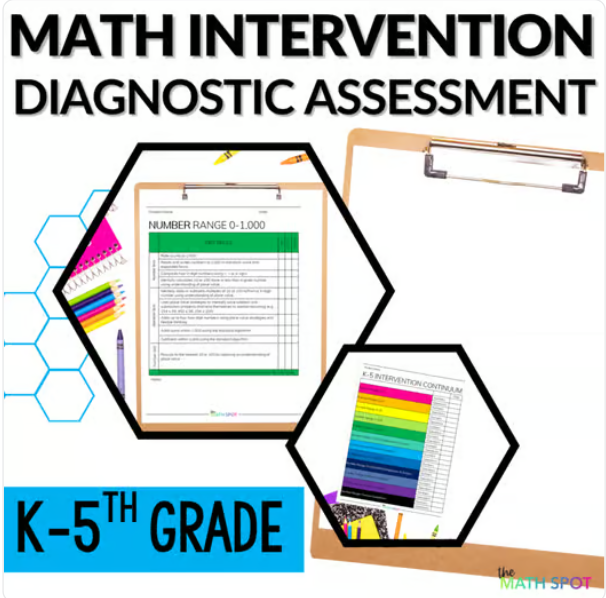
How does the assessment work?
- Determine the range of numbers you believe your student is working in.
- Ask the NUMBERS questions in the interview-style assessment.
- If your student is successful, move ahead to the OPERATIONS questions in that same number range.
- If your student is not yet successful on the numbers questions, move down to the previous range.
- If your student is successful on the numbers AND operations questions, move ahead to the next number range.
- Moving back and forth will help you to determine EXACTLY what your student knows and will indicate the next best step to work on.
Instead of giving you a number score, this assessment helps you pinpoint the skills a student has mastered, what they’re still developing, and where instruction should begin so you can confidently group students and plan instruction that meets their needs.