This post contains affiliate links. This means that when you make a purchase, at no additional cost to you, I will earn a small commission.
Over the past several weeks we have explored different families of visual models and how they develop across grade levels. We have looked at models of the count sequence, part–whole models, discrete models, and area models. Each of these representations supports understanding math in a different way.
The question that often comes up is: How do you choose the right model?
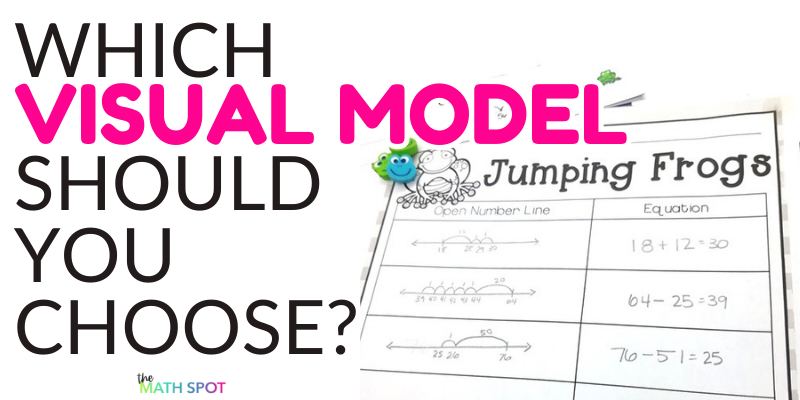
The answer comes down to the purpose of the model. Each visual model highlights a different relationship in mathematics. When you understand what each model is designed to show, it becomes much easier to decide when to use it!
The model you choose should highlight the relationship you want students to see.
Counting Models: Connecting Numbers to the Count Sequence
Counting models connect numbers to the count sequence. These models relate mathematics to a number line and help students see how numbers are positioned relative to one another.
Counting models are especially helpful when students need to see how numbers move forward and backward along the count sequence.
You might choose a counting model when students are:
- Adding or subtracting using mental math
- Moving forward or backward by groups of tens and ones
- Finding the difference between two numbers
- Comparing numbers
For example, a student might use an open number line to subtract 61 − 43. The student could start at 61 and jump back four groups of ten and then three ones. The number line allows students to see the distance between the numbers rather than focusing only on a written algorithm.
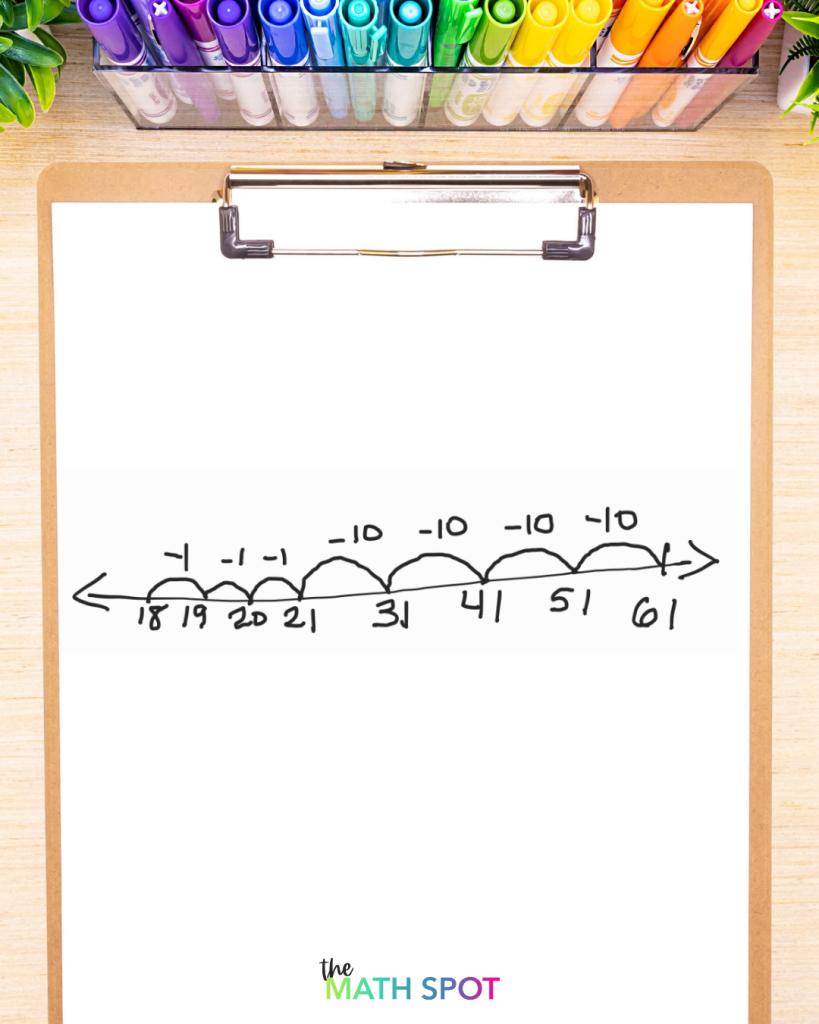
These models show how numbers relate to one another along the count sequence.
Discrete Models: When Students Need to See Every Piece
Discrete models are often the most helpful when students are moving directly from hands-on tools to a visual model. These models still allow students to count each and every piece.
Discrete models are not always the most efficient representation, but they allow students to see all of the math.
You might choose a discrete model when students are:
- First learning to add in kindergarten or first grade
- Drawing equal groups in third grade
- Exploring fractions of a set in upper elementary
- Creating place value drawings that represent tens and ones
For example, a first grader might draw seven circles and then draw three more circles to represent 7 + 3. A third grader might draw four groups of three objects when exploring multiplication. A fourth grader might circle 3 out of 12 objects to represent 3/12 of a set.
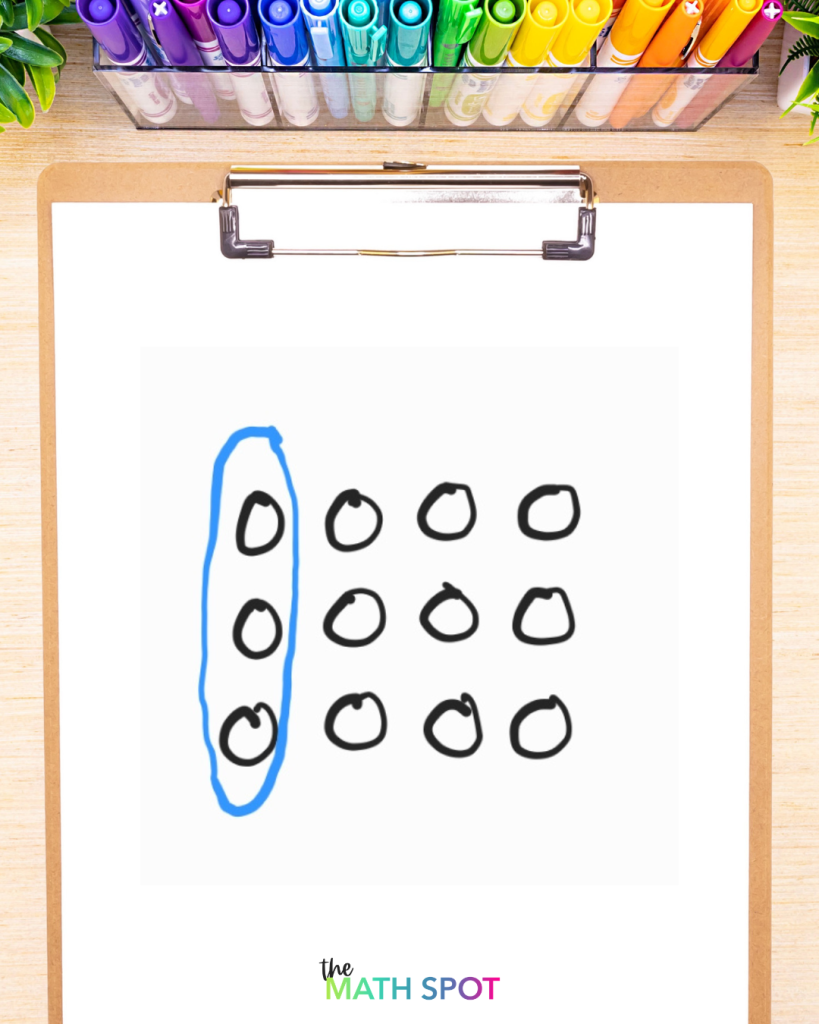
In each case, students are able to count each piece and see how the quantity is built.
Part–Whole Models: Showing Relationships Between Numbers
Part–whole models are designed to show that numbers can be put together and taken apart.
A number bond is a simple example of a part–whole model. Students can see how two parts combine to create a whole or how a whole can be broken into parts.
These models are helpful for students in first and second grade who are studying the relationship between addition and subtraction. They are also helpful for third graders who are studying the relationship between multiplication and division.
Part–whole models are not designed to perform calculations. Their strength is showing how numbers relate to one another.
When students draw a number bond or a bar model, they can see how the numbers in a problem relate to one another. That visual relationship can help lead students to an equation.
Area Models: Extending Multiplication and Division
Area models are particularly useful when students are working with multiplication and division.
Arrays are often the first representation students encounter when learning multiplication. Students can see rows and columns that represent equal groups. As numbers grow larger, drawing or building arrays becomes cumbersome. The area model provides a more efficient way to represent the same idea.
For example, a fourth grader multiplying 23 × 15 can represent the problem using an area model that breaks the numbers into tens and ones. This representation helps students see how partial products combine to make the total.
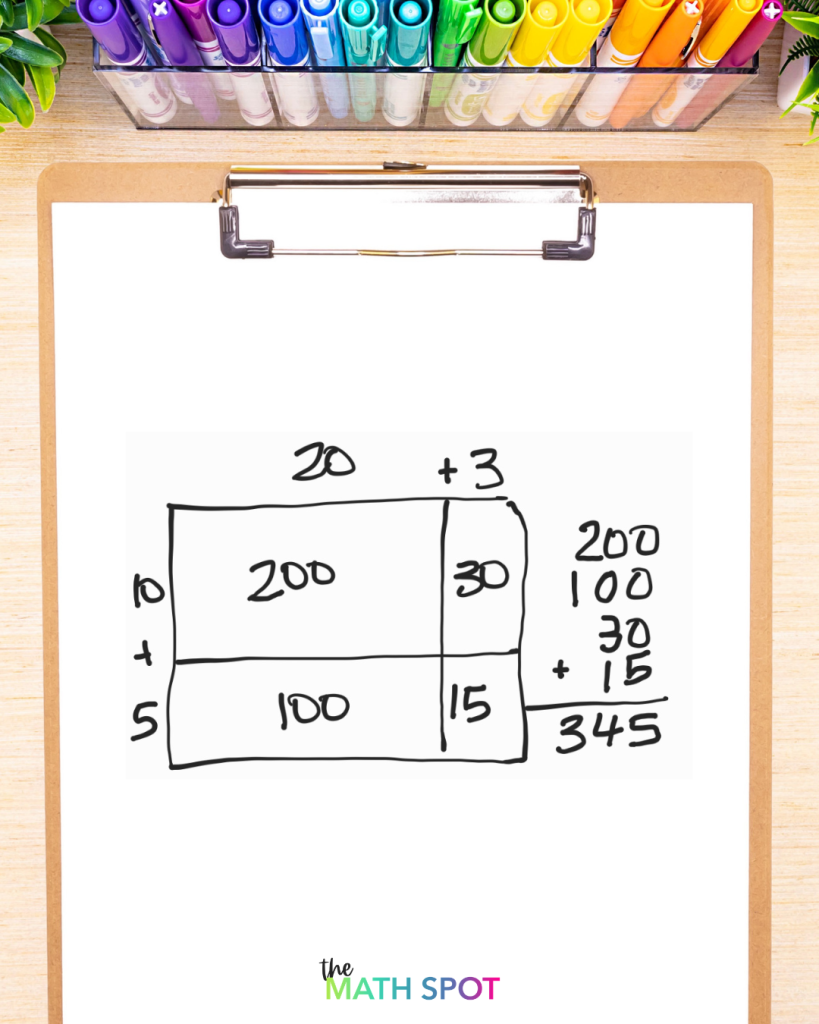
Area models appear again when students begin working with fractions. They can be used to represent fraction multiplication, fraction division, and equivalent fractions.
Matching the Model to the Mathematics
Each visual model highlights a different relationship in mathematics.
- Counting models show how numbers relate to the count sequence.
- Discrete models allow students to see and count each individual piece.
- Part–whole models show how numbers can be combined or separated.
- Area models extend multiplication and division as numbers grow larger.
Choosing the right model depends on what you want students to see.
In some cases, more than one model can represent the same idea. Showing a concept in multiple ways can help students notice patterns and relationships across different representations.
Visual models give students a way to see the mathematics before they rely entirely on symbols and to bridge the gap from hands-on tools to paper-pencil or mental math.